christopher swist


2-21 percussionists and/or pianists
*performance configurations include: piano & large percussion ensemble, piano duo, vibe/marimba duo, percussion trio, percussion quartet
Duration: 8:30
Composed in New Hampshire, 2013
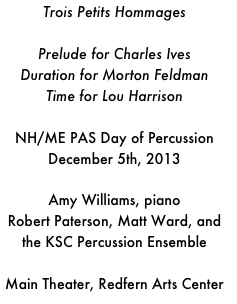
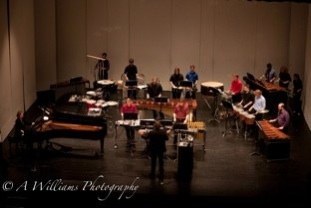
Premier: 12-5-13 Amy Williams, Robert Paterson, Matt Ward, KSC Percussion Ensemble
One of my first percussion ensemble experiences was playing James Tenney’s Three Pieces for Drum Quartet. This set include a wake for Charles Ives, a hocket for Henry Cowell, and a crystal canon for Edgard Varèse. Some 21 years later, I found a crossroad to construct my own tribute to three composers who really caught my ear. In Trois Petits Hommages there is a Prelude for Charles Ives for solo piano (or an option of solo vibraphone). Lifting some impressions of the Concord Sonata, this prelude references the Ivesian tendency for chromatic harmony in a traditional form. The notated score for the prelude is also traditional. In Duration for Morton Feldman, we hear an abbreviated development of pure sound as arrayed on a field of gradual transformation. The score for Duration is open and allows the ensemble (of indeterminate size) to choose entrances and durations in coordination with an electronic soundtrack. At the climax, all 12 chromatic tones are heard at fixed positions throughout a 6 octave register.
Lou Harrison’s contributions to rhythm and the development of the American percussion ensemble have a profound impact on young percussionists. The score for the third movement, Time for Lou Harrison, is arrayed in composed cells of rhythmic and melodic motives that are chosen at the whim of the mixed ensemble. There is a fixed electronic rhythmic sequence that provides the central pulse for the group. Like with Tenney’s canon for Edgar Varese, there is a direct rhythmic quotation from Harrison’s 1941 percussion work Labyrinth No. 3. I had the honor to record this piece with Jan Williams conducting the Maelstrom percussion ensemble in 1997 (Hat Hut HATN105). Lou Harrison once said he hadn’t the faintest idea how to place his work in the progress of Western music. But he would say that, “Lou Harrison is an old man who’s had a lot of fun.”